«Gitahen" coding extraccurricaular program is designed as a curriculum for adult students, as it focuses on an educational methodology that develops both
mathematical and algorithmic thinking. The program spans 2 semesters or 1 academic year. It is recommended to conduct at least 2 lessons per week, with the
possibility of adding additional hours for particularly interested students.
The program goals are to:
- Develop computational thinkingDevelop computational thinking skills through problem decomposition, pattern recognition, and the development of algorithmic thinking. skills through problem decomposition, pattern recognition, and the development of algorithmic thinking
Apply computational thinking to analyze and solve real-world problems.
- Apply computational thinking to analyze and solve real-world Motivate learners to design and execute innovative solutions to complex problems without the need for extensive knowledge of advanced programming
- Motivate learners to design and execute comprehensive, yet languages.
languages.
- Improve digital literacy skills, understanding their Improve digital literacy skills, understanding their capabilities and limitations, as well as algorithmic methods and computational models.
Apply deep mathematical concepts to design, simulate, represent, and analyze efficient algorithms for solving problems.
- Apply deep mathematical concepts to design, simulate, represent, and analyze efficient algorithms for The curriculum and educational content consists of the following topics:
The curriculum and educational content consists of the following topics:
Mathematical graphs
- Mathematical graphs
- Mathematical statistics
- Linear regression
- Interpolating polynomials
- Numerical sequences
- Histogram
- Graphs
- Database
- Introduction to machine learning
- Introduction to neural networks
- Final project
The basis for the development of the program content was the Aylagir coding competition. You can learn more about the Aylagir competition here: ։

About program

Integration in Armenian general education schools
The demand for extracurricular activity
«By implementing the "Gitahen" extracurricular coding activity, we seek to create an educational environment where every learner will be prepared to make data-driven decisions
by making such decisions—to face the challenges of science and technology at the individual, community, and state levels, and will also have the opportunity to
develop their skills and competencies and contribute to the decentralized decentralizeddevelopment of technology.
The slogan of the extracurricular club is: "Synthesizing knowledge and values.»։
The following 4 principles are implemented in the extracurricular club:
a. Development of skills and competencies
We strengthen the skills and competencies of the learners that will help them face the challenges arising from the upcoming developments in the fields of technology (artificial intelligence,
challenges (artificial intelligence, quantum computing).
b. Joint development of knowledge and values
We enhance the mutual development and preservation of knowledge, skills, and Armenian/Universal human values in the learner. Our goal is to shape
individuals who can integrate scientific innovations with their cultural and human values, thus creating harmonious and responsible
specialists.
c. Development of research and data-driven forecasting capacity
We enhance research, data-driven forecasting, decision-making, and planning capacities through engagement with real-life problems and the creation of a healthy competitive
environment.
d. Use of innovative methods
We offer innovative approaches to learning (teaching methodology, competitions, camps, and other activities) through which learners
will be able to study data-driven coding, develop algorithmic thinking, and apply it across various fields.
You can find more details about the necessity of the extracurricular activity and the challenges it addresses here: ։
Program implementation phases
The program was developed by the "ANTROHOOS" Educational Foundation and received a positive conclusion and endorsement MoESCS) and the National Center for Educational Development and Innovation (NCEDI) on April 23, 2024. You can find more details about the program's endorsement
) on April 23, 2024. You can find more details about the program's endorsementhere։
The implementation of the program began in September 2024. The 2024-2025 academic year is conditionally designated as the experimental phase։
Schools selection
For the pilot phase of the program, 5 schools have been selected based on the following criteria:
- Involvement of a teacher/specialist with deep knowledge of mathematics Presence of middle and high school students (grades 7 to 12).
- Presence of middle and high school students (grades 7 to 12A classroom that meets the educational environment requirements (lighting, sanitary conditions, furniture, blackboard, heating).
- Availability of a working internet connection (wired or wireless).
- Availability of ICT tools (at least 5 computers, a screen or projector).
- Engineer-teacher selection requirementsEducation: A degree in computer science or a scientific field is preferred.
- Education: A degree in computer science or a scientific field is preferred.
Experience in teaching: Teachers with experience in teaching STEM (Science, Technology, Engineering, Mathematics) subjects are highly preferred.
- Education: A degree in computer science or a scientific Knowledge of graphic programming languages (e.g., Snap!, Scratch, Blockly, Aghues) and practical experience with them.
- Pedagogical and methodological skills.
- Constructive and friendly approach to learning, researching, and experimenting.
- Full implementation of real-world and life projects.
- Module
- teaching, gradual complexity, guidance, and discovery.
- Differentiated and personalized teaching.
- Game-based learning and creating connections with other subjects.
- Skills in addressing technical problems with a creative approach.
- A desire to cultivate interest and love for science among students.
- Willingness to develop and implement innovative and scientifically-oriented courses.
- Willingness to develop and implement innovative and scientifically-oriented courses.
- Skills in organizing and managing extracurricular group activities.
- Skills in organizing teamwork and collaboration among students.
- Engineer-Teacher TOT (Training of Teachers).
After the selection of teachers, teacher trainings are carried out, regardless of the teacher's skills and knowledge.
The total duration of the teacher training is approximately 40 hours. The training takes place in 2 phases.
- The teacher trainings are conducted by the "ANTROHOOS" Educational Foundation in its in-person format.
- Participation in the teacher training is free of charge, and only teachers from the schools included in the program are eligible to participate.
- Start of the extracurricular activities
The extracurricular activities begin when the following conditions are met:
A memorandum of understanding (MoU) is signed between the foundation and the school.
- The educational content and thematic plan are approved by both the foundation and the school.
- The engineer-teacher has been trained and assigned (Phase 1).
- The engineer-teacher is certified.
- The engineer-teacher is certified.
- The groups are formed.
- The class hour schedule is created.
- The classroom is available or properly furnished.
- Students are informed.
- Parents are informed.
Engineer-teacher
ANAHIT ALOYAN
Selected schools and program launch
Engineer-teacher
GAYANE FANYAN
Engineer-teacher
ARMINE MNATSAKANYAN
Engineer-teacher
LALA KHURSHUDYAN
Engineer-teacher
NAZIK SAROYAN
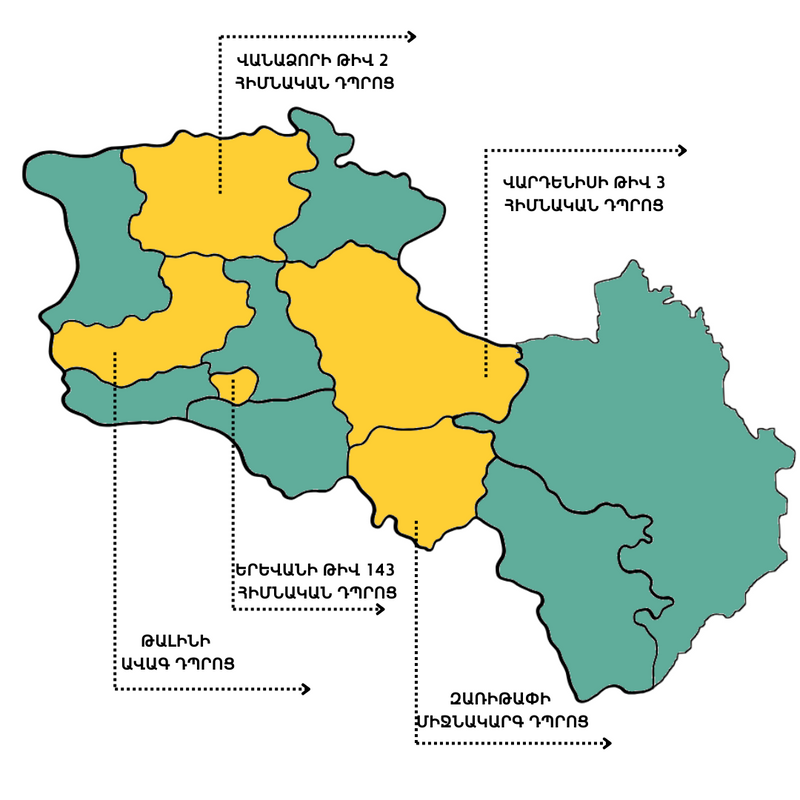
For the pilot phase of the program, 5 public schools have been selected et 1
private non-formal educational center under the Gyumri Development Foundation. The program has been implemented
in both rural and urban areas, in primary, secondary, and high schools.
écoles.
The teachers have been trained, and since September 2024, the extracurricular classes have started in all
extracurricular classes in all 5 schools.
The extracurricular activities are held in the schools' computer science or ICT laboratories, after mandatory
cours obligatoires.
The learners use Berkeley University's snap.berkeley.edu modules
coding platform (block-based). The program interface has been translated into Armenian by the "Antrohoos"
Educational Foundation, while the scientific modules are still in the localization phase.
The developed educational content is licensed for free use and distribution et diffusion
droits.
- Guide méthodologique pour enseignants
- Diapositives de cours pour enseignants
- Manuel de l'élève
- Projet complexe manuel
- Matériaux théoriques
Suivi et extension du programme
After the pilot phase, the extracurricular program will expand and develop both in terms of content and geography. In terms of content,
In terms of content, the integration of simple robotics devices (computer vision) is planned, along with the application of the developed educational materials in other educational
programs. As for geographic expansion, priority will be given to regional and interregional (Javakhk) expansion, as well as activities and collaboration on international
platforms through a franchising model.
Since the start of the pilot phase of the program, the "Antrohoos" Educational Foundation has been conducting a series of ongoing monitoring activities to ensure
the program's effectiveness and continuous development. These include monthly content accountability processes
by teachers, surveys and focus group sessions, satisfaction surveys among students, site visits, informational meetings, as well as continuous monitoring of various activity indicators.
meetings, as well as continuous monitoring of various activity indicators.